

Domitian Arch Gate
Domitian Arch Gate in Pamukkale, Turkey
The Domitian Arch Gate is located within ancient Hierapolis in Pamukkale, near the modern village center and the entrance to the archaeological zone. It is one of the notable monuments of the Roman period in the city: the monumental gate marked the ceremonial entrance and opened onto the main street of Hierapolis, known as Frontinus Street.
The structure dates to the late 1st century AD and is associated with a period of active urban development under the Roman Empire. Originally, the arch had a representative and civic function rather than a defensive one. Later, when Hierapolis was reinforced with fortification walls, the gate was incorporated into the defensive system and round towers were added on the sides, which is why different construction phases are clearly visible in the masonry.
For visitors, the arch is interesting as a clear example of how an ancient city changed over time. It is easy here to imagine the layout of Hierapolis: from the gate begins the straight urban thoroughfare, along which the bases of columns, sections of paving, and fragments of public buildings have been preserved. This is one of the points from which it is convenient to begin exploring the central part of the excavations.
The monument is part of the Hierapolis-Pamukkale archaeological complex, included on the UNESCO World Heritage List. A visit to the gate is usually combined with the ancient theater, the necropolis, the Pamukkale terraces, and the archaeological museum, so the site is especially interesting for those who want to see not an isolated monument but the complete structure of an ancient city.
Domitian Arch Gate on the map
Pamukkale: Archaeological monuments
Pamukkale Aqueduct, Ancient Theatre of Hierapolis
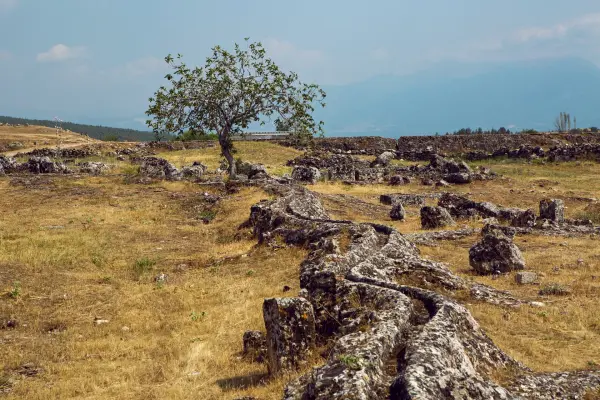
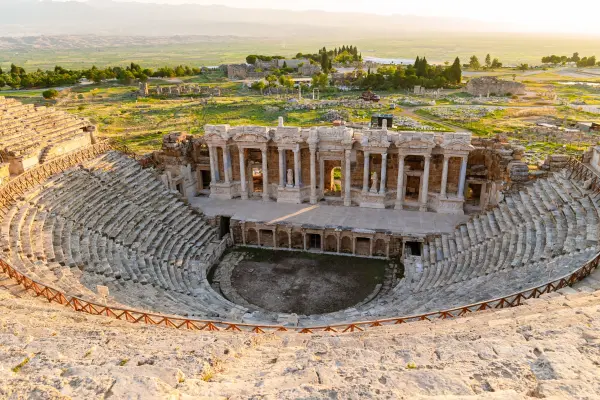
The Domitian Arch Gate in the layout of Hierapolis and its later fortifications
The arch shows the transition from a ceremonial entrance to a defensive element
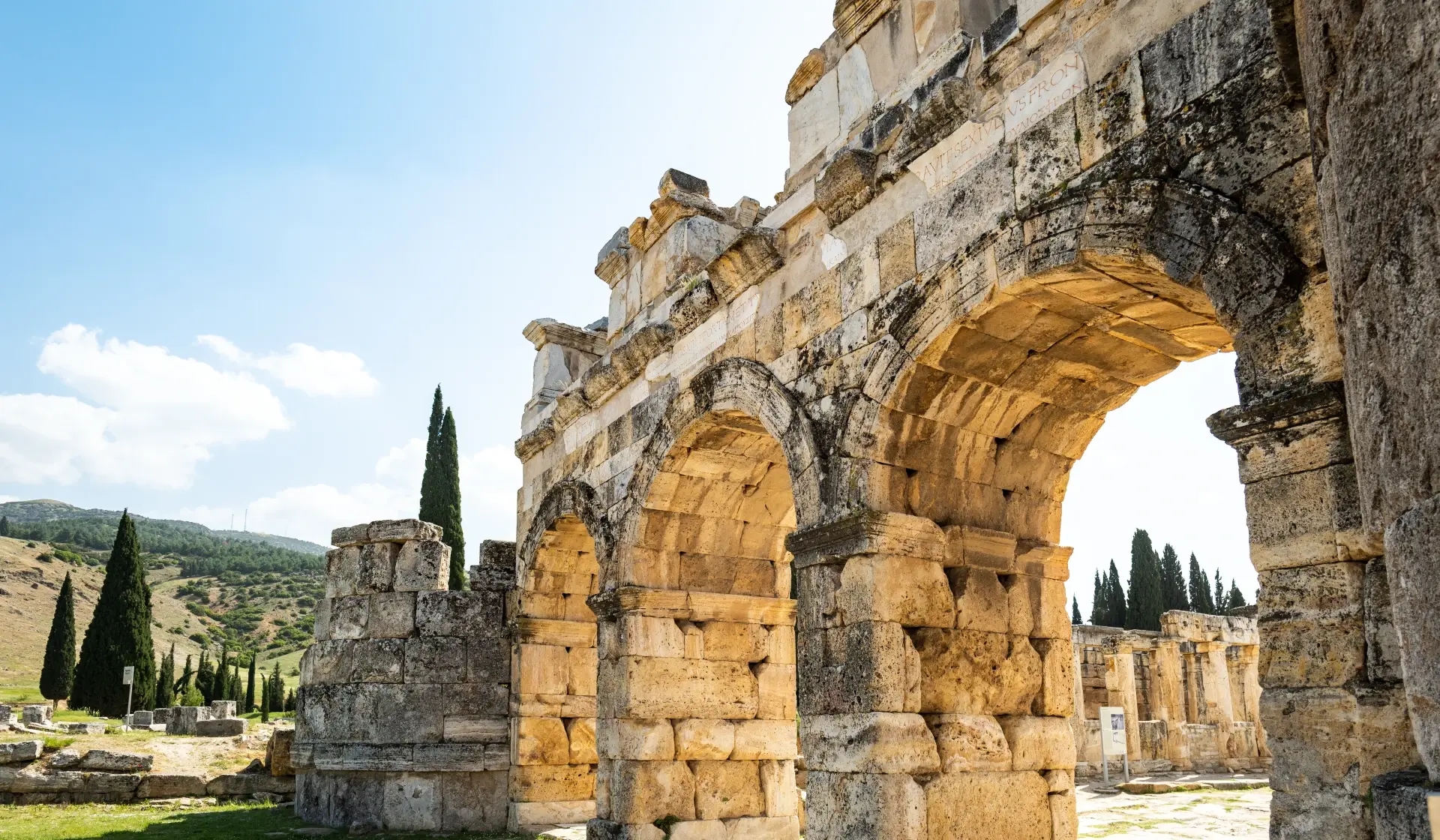
The ceremonial entrance to Roman Hierapolis and the beginning of Frontinus Street
Today, the three passages of the arch and the contrast between the lighter masonry of the main Roman structure and the more massive sections of the later fortifications are most clearly visible at the gate. The side towers have not survived completely, but even from the remaining fragments it is possible to understand how the character of the structure changed - from a ceremonial city entrance to an element of the defensive line.
During your visit, it is worth noting how the gate is aligned with the main street. Beyond it stretches the long axis of the ancient city, and in this section it is easy to see the street layout, the arrangement of the colonnades, and the boundaries of the public space. This is one of those places in Hierapolis where the architecture helps you read the urban structure without complicated explanations.
The gate is usually explored on foot as part of the general route through the excavations. Nearby are Frontinus Street, the Byzantine fortifications, the ancient theater of Hierapolis, and other parts of the archaeological zone, so a stop at the arch can easily be included in a walk across the entire plateau.
You can get here through the entrances to the Pamukkale archaeological complex, after which pedestrian routes through the excavation area lead to the gate. For a visit, it is best to allow time not only for the arch itself but also for the neighboring parts of the ancient city, which are best explored in sequence.
Best tours and travel experiences across the continent




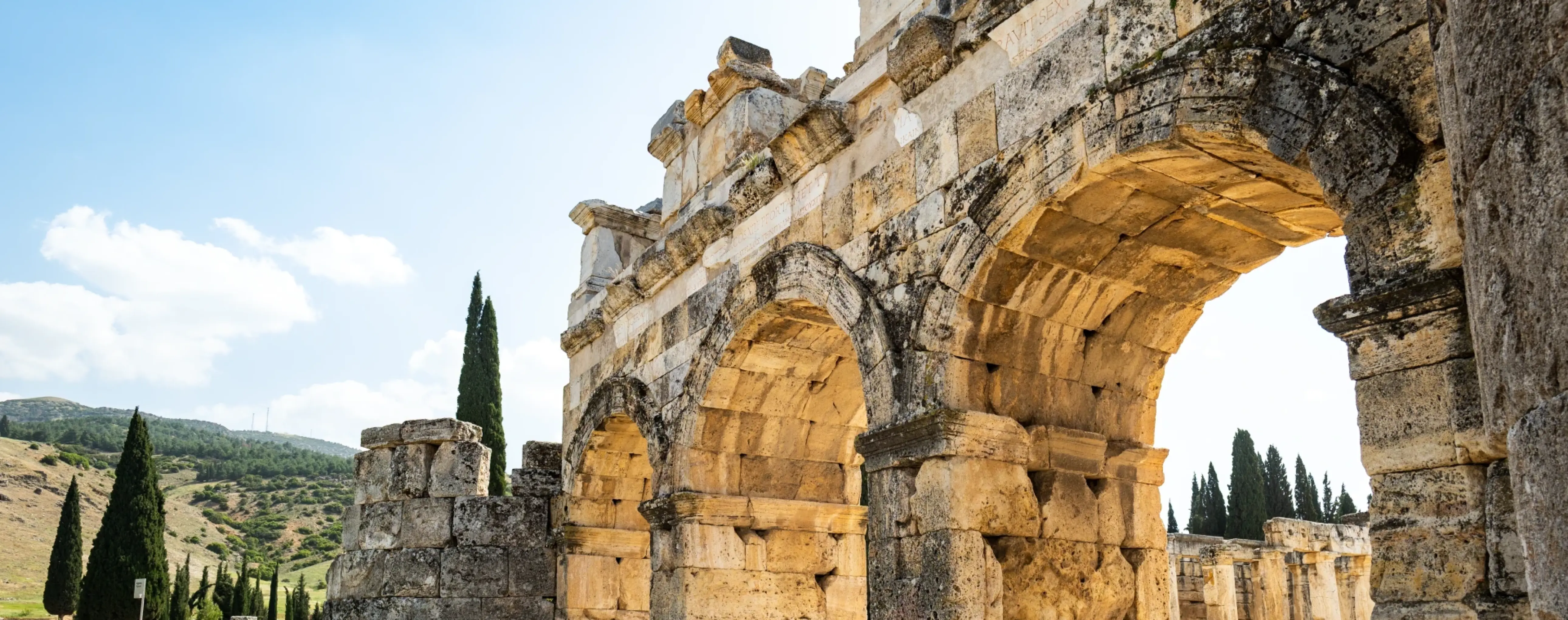
Photo gallery of the gate
Guided tours, popular attractions, and top-rated hotels across the continent


